The good and bad of Bill Clinton was on show at his appearance with John McCain from which leaked his disagreement with Obama on Syria. Clinton understood foreign policy needs but his decisions were made with a finger measuring the political breeze and therefore cautious to the point of insufficiency as far as actually achieving long-term goals. His political calculation on the Rwandan genocide was Clinton's low point, but my chief criticism is that he set up policies and precedents for the terrorism and Saddam problems but neglected to move decisively (and controversially) to resolve the problems on his watch, rather leaving the controversy for his successor to deal with when the problems reached a head. In contrast to Clinton, his successor, Bush, made rational choices to match means with ends and dealt with the controversy that Clinton avoided.
Given the prominent role of Sunni terrorists among the Syrian rebels, the destruction the terrorists caused in neighboring Iraq, and current day terrorist attacks in Iraq likely bleeding over from Syria, I wonder how Obama's decision to give military aid to the Syrian rebels plays in Iraq? It may be the death of any lingering alliance between the US and post-Saddam Iraq. Obama's feckless Middle East policy increasingly vindicates Bush's Middle East policy.
I responded to Professor Nacos about Libya and Iraq here.
John Yoo's take on the Snowden leaks about the NSA surveillance. In short, the program is Constitutional, legal, and fulfills a compelling state interest.
Damn, Nature, you scary! The Cordyceps parasitic fungus take over the mind and body of zombie ants. The ants' cuticle (hardened skin) offers no protection. Not only ants are affected. Different species of Cordyceps attack different insects. There is a variety of parasitic mind control in nature. The complexity of behavior under mind control is striking, such as parasitoid voodoo wasp larvae that control their caterpillar hosts. Who's to say that human beings aren't changed in mind and body by parasites?
Interesting take on the social-political implosive collapse of American society. The life-cycles of parasites that exploit and eventually kill their hosts seems analogous.
Confessions of a Sociopath. Yikes. It seems scary to be around one yet liberating to be one, but also alienating. Hm. Is Amanda Bynes a sociopath?
More sour cream's "I put that beep on everything." Mozzarella cheese, at least the factory version sold in supermarket dairy sections, is more about texture and has subtle flavor to begin with. It loses its flavor in storage. Adding sour cream to bannock pizza made with flavorless mozzarella adds flavor and a creamy texture. I've also used sour cream as a cheese replacement but cooking with the sour cream diminishes its effect. I may substitute a different, more flavorful cheese on my bannock pizza. Sour cream + hot sauce make a creamy, tasty dipping sauce for meat, especially chicken, which needs the flavor boost.
Egg and scallion fried rice and broiled pork with sour cream + hot sauce dipping sauce on the side is decadent.
Approximate broiling guide: 15 total minutes for beef, 25 total minutes for pork, 35 total minutes for chicken. Beef, as I've noted before, has the least room for error in cooking time.
Once again, wet heat (steam) does not cook the same way as dry heat (bake).
3 boxes of 11 oz double chocolate Krave cereal and 1 gallon whole milk for 9 dollars is a pretty good deal, but not a healthy one. I finished the gallon of milk and 1.5 boxes of the Krave in 1 day. That stuff puts on pounds and my body feels off, whether from the chemicals or sugar, afterwards.
I failed to kill an exceptionally quick mosquito last night and today I have a bite on my index finger. It's likely resting in my apartment somewhere digesting my blood. Update: I killed it plus 3 more mosquitoes. What hole(s) are they using to enter my apartment?
Nietzsche excites an MGTOW like Marx excites an activist. The temptation is to be belligerent and defiant of everyone else's conventions and repressions. To expurgate the internalized subjugation and throw off in a zealous burst all the chains of society in every personal interaction as a matter of principle and newly appreciated ego. However, when I am weak, needy, and disenfranchised, an adolescent acting out without a rational purpose is an unnecessary risky behavior. To subjectify myself and solve my alienation must be a thoughtful, long-term - even lifetime - mastery project. Real life is not literally like the movie The Matrix, with a Zion, or even a Nebuchadnezzar, to which to escape the entirety of reality in one move. I can't physically sever my connections to the world and be reborn as a new, greater self in a fantasy world. I must navigate my way out of the trap in this world. The better compromise with Nietzsche's provocation is to critically diagnose the conditions of my objectification, control the internalized repressions within my mind, and learn to know the world for what it is, like Feuerbach's sensual observation. Be situationally aware and self-aware, and respect the power that the world and other people have over me. Then intelligently apply praxis along Marx's original thesis of sensual activity in order to change the circumstances of my objectification. Weigh the risks and rewards. Interact with the world as a rational self-interested free agent. Renegotiate my Hobbesian social contract. Even if I choose to be altruistic again, I must do so from a reified conscious state.
Richard Swanson was an alienated man who died on his praxis quest to actualize his reified consciousness. I don't know that he was red pill, but he was definitely going his own way. By Swanson's and the author's example, the life metamorphasis must be created with dedicated whole mind-body physical activity.
I had a dream about the Stuy bowling team. It wasn't about my truncated time as a bowler, but more my leadership experience recasting the culture of the team that extended beyond my HS career. It wasn't a replay of the actual experience but rather its pattern with different faces, ie, the more things change, the more they stay the same. All of my leadership experiences have been praxis with the Marxist premise that truth is subjective, creative, and deduced rather than objective and induced. The status quo is just an option. However, I eventually reach a point where my internalized subjugation stops me and fills me with doubt with thoughts that Truth is in fact objective, everyone else is in on it, and I am alone, out of tune with a quixotic fantasy. Yet I have made a difference. I have brought my subjective truth to life, just not completely to life at 1st attempt. But that's only a failure from a performance test perspective, not a mastery perspective. Even when change is a smooth run, Daniel Patrick Moynihan said that civil reform requires a 30 year commitment. I certainly have not followed through on any 30 year commitments to completion. So perhaps the obstacles I've run up against are not Truth dispelling my quixotic fantasy, but rather simply breaching the comfort zone of the status quo, aka the blue pill Matrix, Nietzsche's bad air of lies, and Freud's internalized repression. At that point, it's the dominant subjective Truth vs my insurgent subjective Truth, and it requires competition to break through. And that means competing with my teammates who are still shackled by the blue pill status quo and winning over the fencesitters, which I can do, but the uncertainty strikes at my anxieties and insecurities. To compete, I need to trust my capability and my vision and have the iron will - the Nietzschean classical will to excellence - to fight against social pressures to rise alone. The evidence says I can do it in terms of capability, but I must build up my inner game to match my outer game. I must be in control. I also need to figure out what I want to be and the world to be; bigger than morality, the right thing, or selflessly making the world a better place in a Judeo-Christian sense, but what is my truth I want to define my life and with which to change the world.
This NY Times opinion discusses the compounding impact of moral decay and fraying of the social compact in our society. My aspirations for SU4A seem quaint. As an idealist, where could I begin to patch the tearing holes? It's sticking fingers in a dike that's crumbling under a flood.
From the Grantland article on the Spurs' Tracy McGrady: "Most coaches who don't understand young players view 'selfish' as something bad," Carter said. "My thing as a coach is, I can't get a player to be at the level he needs to be at unless he is selfish. He's got to be selfish to invest in himself."
Eric
Showing posts with label iraq. Show all posts
Showing posts with label iraq. Show all posts
Monday, 10 June 2013

Sunday, 12 May 2013
Castillo
Character always wins out.
This story doesn't surprise me.
I knew Sergeant First Class Raymond Castillo as Cadet Candidate Castillo when we were CCs together at USMAPS. I was older, prior service, and higher in the class ranking; nonetheless, I admired him. As young as he was, Castillo shone with the right stuff even then. He was thoughtful, self-aware, tough, and a true believer of duty, honor, country - a born soldier. More, Castillo was a born leader of soldiers in the ideal sense. Even then, he was sure in his principles and lived and breathed the Army values. The only reason he didn't make it to West Point with the rest of us was he couldn't write despite that the best CC writers at USMAPS, including me, did our best to tutor him. It was frustrating because Castillo was smart enough, otherwise a good student, skilled at math, well-spoken, willing to learn, and a hard worker. If he would have simply written his papers the same way he spoke, he would have been fine, but for some reason, there was a disconnect in his brain between his mind and his writing.
Castillo will always be one of my favorite people. My civil-military advocacy in college and my efforts to counter misrepresentations of the Iraq mission were motivated by soldiers like him. They are good, honorable men - worthier, stronger men than I am - the best of Americans who have risked themselves for duty, honor, country. They've earned it. They are righteous. They deserve to be empowered and honored for their selfless service and sacrifice.
Eric
Thursday, 9 May 2013
Thoughts of the day
I agree with Ethan Chorin that President Obama's misguided Libya policy set the stage for the Benghazi consulate attack and other deleterious effects. For a liberal leadership posture, Bush's Middle East policy was correct. By retaining the same liberal posture yet switching course based on the faulty premise that Bush's Middle East policy was incorrect, Obama's Middle East policy has gone wrong.
2004 CNN report with Clinton supporting Bush on Iraq:
As shown by Clinton's quote, the Democrats understood the context and stakes in Iraq, yet they still distorted the public perception of the Iraq mission for parochial partisan gain. This postsecret from May 18 reminds me of the layers of damage caused by the misinformation, propaganda, and false narrative against the Iraq mission that the Democrats validated. Let's see whether this and this make a difference.
Bravo, Richard Kemp. More of this needs to be said and often about our roles in Iraq and Afghanistan. I would emphasize more the liberal and humanitarian aspects of our peace operations, but he takes the narrative in the right direction by critically spotlighting and contrasting the nature of the enemy. We need a better, stronger narrative. The leftist anti-peace narrative works hand in hand with the Islamic terrorist narrative to deadly result.
Bravo, Michelle Malkin. This is the right tack to criticize Obama's hypocrisy and overreach, and rehabilitate Bush's legacy while not throwing out the baby of national security and the War on Terror with the bathwater. Make Bush the standard and hold Obama to it.
I haven't been following the Jason Richwine controversy, but here's his side of it. Judgybitch's take.
Abandoned places, such as the abandoned showpiece City Hall subway station.
Youtube fun:
Schmoyoho's (Gregory Brothers) Churchill remix. Churchill is a soul brother.
A red-pill song by Matt Hires: Restless Heart.
The Crazy Nasty Ass Honey Badger (original narration by Randall).
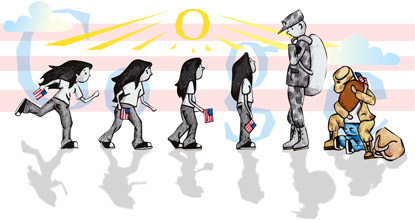
Touching google doodle of a girl excited, then apprehensive and tentative, then finally released and intimate with her military dad when he comes home from a deployment. The theme is Best Day Ever and the artist is contest winner Sabrina Brady.
Who you are, character, personality, intrinsic self, inner game is determinative. It always wins out. Talent, skill, resources, given advantages, and luck are just tools. What you do is episodic. Character is thematic. In the end, you are what your record says you are.
Free Northerner's manly reading lists. Compare to Columbia's renowned Core Curriculum.
Project Gutenberg - classics for free on-line.
Story of a family who travelled from a Lockean state, the UK, to visit family in India and fell into a Hobbesian nightmare.
At some point, I'll make a separate post for Szelenyi's lectures, like my knots progress post.
What's happening to good-girl paragon Amanda Bynes? Her fall is yet another harsh disillusioning blow to my idealism where a hitherto unimpeachable American paragon is brought low in shocking and/or sordid fashion, like Lance Armstrong, Alex Rodriguez, Lehman Brothers, Columbia space shuttle, GEN Petraeus, Bernie Madoff, Tiger Woods, Horace Mann, and Penn State. Bynes was seemingly the most stable and virtuous of her peers, yet her fall has been the hardest. It's like Taleb's black swan enacted on a personal level. Insight from Mara Wilson.
A red-pill explanation for Bynes's breakdown: The truth about female desire: It’s base, animalistic and ravenous. It may be, at least in part, her nature breaking free.
Duke of Earl by Gene Chandler. "As I walk through this world, nothing can stop the Duke of Earl ... Nothing can stop me now, coz I'm the Duke of Earl!"
Goodnite, Sweetheart, Goodnite by the Spaniels. "Good night, sweetheart, well, it's time to go. I hate to leave you, but I really must say, oh good night, sweetheart, good night." "Baby, I just can't get right. Well, I hate to leave you, baby, I don't mean maybe, because I love you so." That's what it felt like when I left Korea, the Army, and her behind. To summarize, Every Little Thing She Does is Magic by the Police, Can't Fight This Feeling by REO Speedwagon, Teenager in Love by Dion and the Belmonts, and Goodnite, Sweetheart, Goodnite by the Spaniels sing the love story that wasn't. Rollo explains the 'click' together but ... mystery.
Sorrow.
Honor your father and mother by begetting children.
Sarah at Trying to Grok regrets waiting too long to start having children and recommends women should start their families before age 25.
Narcotics Anonymous: "Insanity is repeating the same mistakes and expecting different results."
7 stages of grief (modified Kubler-Ross): Shock - Denial - Anger - Bargain - Depression - Testing - Acceptance.
Pulp Fiction Ezekiel 25:17 (the whole scene; revisited in the final scene). "The path of the righteous man is beset on all sides by the inequities of the selfish and the tyranny of evil men. Blessed is he who, in the name of charity and good will, shepherds the weak through the valley of darkness, for he is truly his brother's keeper and the finder of lost children. And I will strike down upon thee with great vengeance and furious anger those who would attempt to poison and destroy my brothers. And you will know my name is the Lord when I lay my vengeance upon thee!"
No matter how much a drill sergeant yells at you while smoking you (and your fellow privates) in the pit or anywhere else, muscle failure is muscle failure. Where the drill sergeant makes a difference is your muscular capacity is higher than your perception of your muscular capability. The drill sergeant bullies you past the limits of your perception, gets more out of your capacity, and thereby improves your capability more than you would have on your own.
Principle is fine - it's the ought. But power comes first - it's the real that is.
Andy Greenwald on the moral of the Game of Thrones's Red Wedding - the practical purpose for the fiction of idealism and the danger of codes of honor: "Jon Snow is a bastard, born outside of the tight web of convention that gave Ned meaning and purpose, the same fiction that Varys spoke of a few weeks back as being essential to keeping an empire from falling into chaos. While there's enough Ned in him to save the life of the elderly horsetrader — and blow his own cover in the process — Jon's still fluid enough in his worldview and allegiance to keep him alive for the foreseeable future." Rational choice wins. Greenwald's post is worth reading even if you (like I) haven't watched the show. It's a prescription for the red pill. "Greater good", "make a difference", and "make the world a better place" can be spun, interpreted, and modified to mean a number of different things.
Related to that the frame of the problem informs the solution, knowing parties, premises, (first) principles, purpose, and definitions tells you the rest.
I made myself a bannock pizza deep dish style using my 3 quart mixing bowl in the Nesco. It worked. The crust tasted, looked, and felt (texture) like a reasonable approximation of a deep dish pizza crust. I left the bannock dough in the refrigerator overnight because I wasn't hungry. I learned that chilled bannock dough, like chilled brownie paste, also flour based, is easier to work with than just-made bannock dough. The cooked crust seemed thicker than usual, too. I'm not sure whether it tasted different, though the bitter taste from the baking soda seemed less.
This time, I let the Duncan Hines dark chocolate fudge brownie cool completely before eating it. Cooled, but not cold, the texture was more brownie-like and seemed to taste better, too.
I tried mixing evaporated milk into my last dark chocolate brownie mix. The result was the consistency was more brownie like. Still low on taste, though.
I bought Duncan Hines dark chocolate fudge cake mix on sale for 1.25 for a 16.5 ounce box. Ugh. It's tasteless, more tasteless even than the Duncan Hines dark chocolate fudge brownie mix. Granted, cakes are meant to be frosted, but the cake portion should have at least some flavor. The texture is cake texture rather than the relatively denser brownie. Adding evaporated milk to the cake batter makes the cake spongier.
I wonder why chicken takes longer to cook than pork. Less dense muscle fiber?
Golden Krust honey barbecue jerk sauce is quite tasty as a dipping sauce. Hunts hickory & brown sugar barbecue sauce is too strong as a dipping sauce and okay as a pre-cook baste - quite sticky, though, due to the corn syrup.
The turkey sausage is a pain in the ass. I just ate 2 bites that were half raw. How am I supposed to know the inside is no longer pink? I'm going to try boiling one next time before I grill it, like how I broil my pork before grilling it. I'm just afraid the tasty oil will leak out of the sausage when I boil it.
.99/lb pork neck bones - not worth it for the meat. A lot of bone for broth, though.
Best Yet frozen southern selection cut okra is good. Slimy, so I cook it with my rice so the slime is soaked up in the rice.
Bachelor meat-sauce pasta shortcut: Add the uncooked pasta directly to the sauce. Add enough liquid for the pasta to plump. The Mirro and burner worked well for making the meat-sauce pasta. Bachelor meat-sauce pasta is illusory. It looks like a heaping pile (as I've noted before) and tastes okay, but it's not filling, so it goes quick.
The canned salmon makes for a decadent bachelor stew with Progresso soup. Earlier, I tried making a bachelor stew with a can of crushed tomatoes rather than soup and ended up with something like a weaker bachelor meat sauce, which I usually make with ground turkey, chicken, or pork. Today, I tried making a bachelor meat sauce pasta with the canned salmon (scallion greens, canned corn, frozen spinach, crushed tomatoes with basil). Pretty much the same result as the bachelor stew-turned-sauce. Not bad, but the canned salmon is miscast with the meat sauce. The salmon is weaker flavored with the crushed tomatoes than with the Progresso soup for some reason - tomato juice neutralizing the salmon oil, perhaps? From now on, I'm sticking with pork, turkey, or chicken for the meat sauce pasta and the canned salmon will be reserved for stew. Plus, I'm quite pleased with the Mirro so far.
With the Sunbeam wounded, I could use a skillet, frying pan, or wok for my single burner. I'm waiting for one to turn up for scavenging. I can only cook so many ways with the grill pan. At least one frying pan was available, but I declined to take it at the time because my Sunbeam was still healthy and I wasn't using my burner yet. Just goes to show, gotta think ahead.
I recovered a Circulon stove-top grill pan insert but without its holder/drip pan. It looked sort of like a skillet. I can't use it to cook without its holder unless I use it concave or underside side up, and I don't know that the underside is safe to cook on. I can't think of any other use for it. So, back in the recycling bin it goes. Oh well.
16MAY13: I scavenged an aluminum Mirro-matic electric frying pan today. I guess it was discarded because it's missing its power supply, so now it's just a frying pan, no longer electric. It's otherwise in good shape. The lid is intact and it's been scrubbed clean. It has scratches, some discolorations, and stubborn (soybean) vegetable oil stains in all the hard-to-scrub places. The key, and lucky, characteristic of the pan is its bottom fits onto my burner. The Mirro-matic has a 15-cup (120 ounce) capacity, compared to 12 cups for the 3-quart mixing bowl and 9 cups for the Sunbeam.
In cooking and other useful endeavors, the right tool for the job makes a big difference and trial and error is necessary for improvement beyond the limits of conception.
Eric
2004 CNN report with Clinton supporting Bush on Iraq:
Clinton, who was interviewed Thursday, said he did not believe that Bush went to war in Iraq over oil or for imperialist reasons but out of a genuine belief that large quantities of weapons of mass destruction remained unaccounted for.
Noting that Bush had to be "reeling" in the wake of the attacks of September 11, 2001, Clinton said Bush's first priority was to keep al Qaeda and other terrorist networks from obtaining "chemical and biological weapons or small amounts of fissile material."
"That's why I supported the Iraq thing. There was a lot of stuff unaccounted for," Clinton said in reference to Iraq and the fact that U.N. weapons inspectors left the country in 1998.
"So I thought the president had an absolute responsibility to go to the U.N. and say, 'Look, guys, after 9/11, you have got to demand that Saddam Hussein lets us finish the inspection process.' You couldn't responsibly ignore [the possibility that] a tyrant had these stocks," Clinton said.
As shown by Clinton's quote, the Democrats understood the context and stakes in Iraq, yet they still distorted the public perception of the Iraq mission for parochial partisan gain. This postsecret from May 18 reminds me of the layers of damage caused by the misinformation, propaganda, and false narrative against the Iraq mission that the Democrats validated. Let's see whether this and this make a difference.

Bravo, Richard Kemp. More of this needs to be said and often about our roles in Iraq and Afghanistan. I would emphasize more the liberal and humanitarian aspects of our peace operations, but he takes the narrative in the right direction by critically spotlighting and contrasting the nature of the enemy. We need a better, stronger narrative. The leftist anti-peace narrative works hand in hand with the Islamic terrorist narrative to deadly result.
Bravo, Michelle Malkin. This is the right tack to criticize Obama's hypocrisy and overreach, and rehabilitate Bush's legacy while not throwing out the baby of national security and the War on Terror with the bathwater. Make Bush the standard and hold Obama to it.
I haven't been following the Jason Richwine controversy, but here's his side of it. Judgybitch's take.
Abandoned places, such as the abandoned showpiece City Hall subway station.
Youtube fun:
Schmoyoho's (Gregory Brothers) Churchill remix. Churchill is a soul brother.
A red-pill song by Matt Hires: Restless Heart.
The Crazy Nasty Ass Honey Badger (original narration by Randall).
Touching google doodle of a girl excited, then apprehensive and tentative, then finally released and intimate with her military dad when he comes home from a deployment. The theme is Best Day Ever and the artist is contest winner Sabrina Brady.
Who you are, character, personality, intrinsic self, inner game is determinative. It always wins out. Talent, skill, resources, given advantages, and luck are just tools. What you do is episodic. Character is thematic. In the end, you are what your record says you are.
Free Northerner's manly reading lists. Compare to Columbia's renowned Core Curriculum.
Project Gutenberg - classics for free on-line.
Story of a family who travelled from a Lockean state, the UK, to visit family in India and fell into a Hobbesian nightmare.
At some point, I'll make a separate post for Szelenyi's lectures, like my knots progress post.
What's happening to good-girl paragon Amanda Bynes? Her fall is yet another harsh disillusioning blow to my idealism where a hitherto unimpeachable American paragon is brought low in shocking and/or sordid fashion, like Lance Armstrong, Alex Rodriguez, Lehman Brothers, Columbia space shuttle, GEN Petraeus, Bernie Madoff, Tiger Woods, Horace Mann, and Penn State. Bynes was seemingly the most stable and virtuous of her peers, yet her fall has been the hardest. It's like Taleb's black swan enacted on a personal level. Insight from Mara Wilson.
A red-pill explanation for Bynes's breakdown: The truth about female desire: It’s base, animalistic and ravenous. It may be, at least in part, her nature breaking free.
Duke of Earl by Gene Chandler. "As I walk through this world, nothing can stop the Duke of Earl ... Nothing can stop me now, coz I'm the Duke of Earl!"
Goodnite, Sweetheart, Goodnite by the Spaniels. "Good night, sweetheart, well, it's time to go. I hate to leave you, but I really must say, oh good night, sweetheart, good night." "Baby, I just can't get right. Well, I hate to leave you, baby, I don't mean maybe, because I love you so." That's what it felt like when I left Korea, the Army, and her behind. To summarize, Every Little Thing She Does is Magic by the Police, Can't Fight This Feeling by REO Speedwagon, Teenager in Love by Dion and the Belmonts, and Goodnite, Sweetheart, Goodnite by the Spaniels sing the love story that wasn't. Rollo explains the 'click' together but ... mystery.
Sorrow.
Honor your father and mother by begetting children.
Sarah at Trying to Grok regrets waiting too long to start having children and recommends women should start their families before age 25.
Narcotics Anonymous: "Insanity is repeating the same mistakes and expecting different results."
7 stages of grief (modified Kubler-Ross): Shock - Denial - Anger - Bargain - Depression - Testing - Acceptance.

Pulp Fiction Ezekiel 25:17 (the whole scene; revisited in the final scene). "The path of the righteous man is beset on all sides by the inequities of the selfish and the tyranny of evil men. Blessed is he who, in the name of charity and good will, shepherds the weak through the valley of darkness, for he is truly his brother's keeper and the finder of lost children. And I will strike down upon thee with great vengeance and furious anger those who would attempt to poison and destroy my brothers. And you will know my name is the Lord when I lay my vengeance upon thee!"
No matter how much a drill sergeant yells at you while smoking you (and your fellow privates) in the pit or anywhere else, muscle failure is muscle failure. Where the drill sergeant makes a difference is your muscular capacity is higher than your perception of your muscular capability. The drill sergeant bullies you past the limits of your perception, gets more out of your capacity, and thereby improves your capability more than you would have on your own.
Principle is fine - it's the ought. But power comes first - it's the real that is.
Andy Greenwald on the moral of the Game of Thrones's Red Wedding - the practical purpose for the fiction of idealism and the danger of codes of honor: "Jon Snow is a bastard, born outside of the tight web of convention that gave Ned meaning and purpose, the same fiction that Varys spoke of a few weeks back as being essential to keeping an empire from falling into chaos. While there's enough Ned in him to save the life of the elderly horsetrader — and blow his own cover in the process — Jon's still fluid enough in his worldview and allegiance to keep him alive for the foreseeable future." Rational choice wins. Greenwald's post is worth reading even if you (like I) haven't watched the show. It's a prescription for the red pill. "Greater good", "make a difference", and "make the world a better place" can be spun, interpreted, and modified to mean a number of different things.
Related to that the frame of the problem informs the solution, knowing parties, premises, (first) principles, purpose, and definitions tells you the rest.
I made myself a bannock pizza deep dish style using my 3 quart mixing bowl in the Nesco. It worked. The crust tasted, looked, and felt (texture) like a reasonable approximation of a deep dish pizza crust. I left the bannock dough in the refrigerator overnight because I wasn't hungry. I learned that chilled bannock dough, like chilled brownie paste, also flour based, is easier to work with than just-made bannock dough. The cooked crust seemed thicker than usual, too. I'm not sure whether it tasted different, though the bitter taste from the baking soda seemed less.
This time, I let the Duncan Hines dark chocolate fudge brownie cool completely before eating it. Cooled, but not cold, the texture was more brownie-like and seemed to taste better, too.
I tried mixing evaporated milk into my last dark chocolate brownie mix. The result was the consistency was more brownie like. Still low on taste, though.
I bought Duncan Hines dark chocolate fudge cake mix on sale for 1.25 for a 16.5 ounce box. Ugh. It's tasteless, more tasteless even than the Duncan Hines dark chocolate fudge brownie mix. Granted, cakes are meant to be frosted, but the cake portion should have at least some flavor. The texture is cake texture rather than the relatively denser brownie. Adding evaporated milk to the cake batter makes the cake spongier.
I wonder why chicken takes longer to cook than pork. Less dense muscle fiber?
Golden Krust honey barbecue jerk sauce is quite tasty as a dipping sauce. Hunts hickory & brown sugar barbecue sauce is too strong as a dipping sauce and okay as a pre-cook baste - quite sticky, though, due to the corn syrup.
The turkey sausage is a pain in the ass. I just ate 2 bites that were half raw. How am I supposed to know the inside is no longer pink? I'm going to try boiling one next time before I grill it, like how I broil my pork before grilling it. I'm just afraid the tasty oil will leak out of the sausage when I boil it.
.99/lb pork neck bones - not worth it for the meat. A lot of bone for broth, though.
Best Yet frozen southern selection cut okra is good. Slimy, so I cook it with my rice so the slime is soaked up in the rice.
Bachelor meat-sauce pasta shortcut: Add the uncooked pasta directly to the sauce. Add enough liquid for the pasta to plump. The Mirro and burner worked well for making the meat-sauce pasta. Bachelor meat-sauce pasta is illusory. It looks like a heaping pile (as I've noted before) and tastes okay, but it's not filling, so it goes quick.
The canned salmon makes for a decadent bachelor stew with Progresso soup. Earlier, I tried making a bachelor stew with a can of crushed tomatoes rather than soup and ended up with something like a weaker bachelor meat sauce, which I usually make with ground turkey, chicken, or pork. Today, I tried making a bachelor meat sauce pasta with the canned salmon (scallion greens, canned corn, frozen spinach, crushed tomatoes with basil). Pretty much the same result as the bachelor stew-turned-sauce. Not bad, but the canned salmon is miscast with the meat sauce. The salmon is weaker flavored with the crushed tomatoes than with the Progresso soup for some reason - tomato juice neutralizing the salmon oil, perhaps? From now on, I'm sticking with pork, turkey, or chicken for the meat sauce pasta and the canned salmon will be reserved for stew. Plus, I'm quite pleased with the Mirro so far.
With the Sunbeam wounded, I could use a skillet, frying pan, or wok for my single burner. I'm waiting for one to turn up for scavenging. I can only cook so many ways with the grill pan. At least one frying pan was available, but I declined to take it at the time because my Sunbeam was still healthy and I wasn't using my burner yet. Just goes to show, gotta think ahead.
I recovered a Circulon stove-top grill pan insert but without its holder/drip pan. It looked sort of like a skillet. I can't use it to cook without its holder unless I use it concave or underside side up, and I don't know that the underside is safe to cook on. I can't think of any other use for it. So, back in the recycling bin it goes. Oh well.
16MAY13: I scavenged an aluminum Mirro-matic electric frying pan today. I guess it was discarded because it's missing its power supply, so now it's just a frying pan, no longer electric. It's otherwise in good shape. The lid is intact and it's been scrubbed clean. It has scratches, some discolorations, and stubborn (soybean) vegetable oil stains in all the hard-to-scrub places. The key, and lucky, characteristic of the pan is its bottom fits onto my burner. The Mirro-matic has a 15-cup (120 ounce) capacity, compared to 12 cups for the 3-quart mixing bowl and 9 cups for the Sunbeam.

BRht7T(ogg~~60_3.JPG)
In cooking and other useful endeavors, the right tool for the job makes a big difference and trial and error is necessary for improvement beyond the limits of conception.
Eric
Saturday, 27 April 2013
My responses to CNN hit piece against President Bush
CNN article "History's jury is still out on George W. Bush" by Julian Zelizer.
My response to the author:
Comment. My response:
My response to the author:
Professor Zelizer, I disagree with you on several points. I'll focus on one point here: your analysis is flawed by crediting Bush with harmful effects of Obama's policy decisions where he changed course from Bush.I also engaged in a comment thread:
Our Iraq mission was trending as a success at the point that Obama and Biden badly bungled the SOFA negotiation. It's as though Eisenhower somehow fumbled away Germany, Japan, and Korea, for whom US-led nation-building also required many years, at their critical turning points.
By the close of the Bush administration, the US presence in geopolitically critical Iraq was settling into a stabilizing role like our long-term presence in Europe and Asia. Obama's failure in Iraq has led to, at the very least, a stronger position for Iran, decrease of US options in the region, and the heightened risk of reversing hard-won progress in Iraq. Like Germany in Europe and Japan in Asia, an empowered liberal Iraq should have been the lynchpin of our Middle East strategy. Now, we can only hope the US did enough for Iraq to resist corrupting influences and stand on its own before our premature exit.
The Arab Spring occurred during the Obama administration. It, indeed, was likely inspired in part by Bush's liberal initiatives. However, Bush's Freedom Agenda was a long-term plan for controlled, measured progress from autocratic rule to liberal modernity in the Middle East with active US assistance. Obama scrapped Bush's Freedom Agenda in favor of "leading from behind", which turned into short-sighted ad hoc applications of US power. Predictably, with poorly and unevenly applied US assistance, the Arab Spring has degenerated from its early aspirations.
Islamic terrorism suffered a massive defeat in Iraq at the hands of the US-led coalition and the Iraqi people. Predictably, Islamic extremists have stepped in where the US has stepped away under Obama and appear to be having a resurgence in the winner-take-all chaos of the Arab Spring.
Obama's dramatic escalation of drone kills is also a departure from Bush.
The counter-terror industry consensus is that the Bush administration was very effective at breaking down Islamic terror networks and organizations. As such, no more Islamic terror attacks were successfully carried out in the US for the remainder of the Bush administration.
However, Islamic terrorism is adaptive and resilient. Because Bush administration efforts successfully reduced organized Islamic terrorism (which again, appears to be having a resurgence in the Arab Spring), anti-US Islamic terrorism has shifted to the Anwar al-Awlaki brand of self-actualizing 'lone wolf' attacks. As such, there has been an upsurge of self-actualized Islamic terrorist attacks during the Obama administration.
The Boston Marathon attacks can't be credited to the Bush administration. They happened 4+ years after the Bush administration within a shift in anti-US Islamic terrorism that evolved on Obama's watch. The drone killing of Anwar al-Awlaki shows the Obama administration identified that shift in Islamic terrorism. The question is whether homeland security under the Obama administration failed to adapt sufficiently to the shift.
Comment. My response:
Bush made the right call on Iraq. If you're against a last chance for Saddam to comply, then your only alternatives are maintaining an indefinite toxic status quo or freeing a noncompliant Saddam. Keep in mind that a founding reason for al Qaeda in the 1990s was our indefinite toxic status quo in Iraq where we were rendered effectively complicit with Saddam's harm of the Iraqi people.Comment. My response:
Iraq's guilt was established and presumed as the basis of the Gulf War ceasefire and UNSC resolutions on weapons, humanitarian, and terrorism standards. Saddam's noncompliance was established. There was no burden on the US and UN to prove Iraq's guilt. The burden was entirely on Saddam to prove his compliance. Over 12 years, Saddam was given multiple chances to pass. In 2002-03, he failed for the last time.
Saddam did not even try to pretend compliance with the humanitarian standards, which were equally triggers for war as the weapons standards, which he also failed. Saddam was in fact guilty.
The alternative choices were not better. The default was an indefinite toxic,
provocative, harmful, expensive stalemate. The only other alternative was to free a noncompliant Saddam.
It's not the US presence that has caused pain in Iraq. First, the pain in Iraq was caused by Saddam. After Saddam, the US was dedicated to peace operations in Iraq, just as we've built lasting peace in other countries we've occupied. But great pain was caused by the Islamic terrorist onslaught in Iraq. To our credit, we honored our promise and refused to abandon the Iraqi people to the terrorists.
Again, if you're opposed to giving Saddam a last chance to comply, then would you have maintained the toxic status quo indefinitely or freed a noncompliant Saddam?
Again, it was not the US or UN's place to prove Iraq was guilty. Iraq was established and presumed guilty as the basis of the ceasefire and UNSC resolutions. The burden was *entirely* on Saddam to prove his rehabilitation. With Saddam, we had to be sure.Comment. My response:
The argument of Iraq's innocence is based on information after the fact and unrelated to the relevant procedure. In fact, Saddam was guilty.
The justifications for OIF aren't retroactive. See the 2002 Congressional authorization and UNSC resolution 1441. The baseline case against Saddam was diverse. The threat of Saddam was part and parcel with the 12 year course with Iraq.
Moreover, the case against Saddam was mature by Operation Desert Fox in 1998 when Clinton set regime change as the solution for the Iraq problem, labeled Saddam a "clear and present" danger irrespective of possession of WMD, and declared Saddam had failed his "final chance".
Saddam posed a threat distinct from other nations because his belligerence combined with his repeated crossing of red lines under dire warning that other actors have not crossed. Saddam showed he could not be treated like a rational actor.
The US was also in an a uniquely direct and harmful relationship with Iraq that needed to be resolved, especially in the wake of 9/11. Keep in mind that the most visible, provocative, expensive, and dangerous part of our pre-OIF mission in Iraq - the no-fly zones - were enforcing humanitarian standards, not weapons standards. Clinton intervened in the Balkans on humanitarian grounds before Bush and Obama intervened in Libya on humanitarian grounds after Bush. Humanitarian grounds were included in the Iraq intervention.
9/11 merely emphasized and highlighted the existing terrorism part of the case against Saddam, which had dated to the earliest UNSC resolutions on Iraq. Clinton also acted on Saddam's terrorist threat. Saddam didn't need al Qaeda to be a terrorist; he had demonstrated his own capacity and willingness to use unconventional warfare.
To be accurate, "imminent" threat was not cited. Actually, Bush said that for an unconventional threat like terrorism, we cannot afford to wait for indications of an imminent threat, like we can for a conventional threat. In a terrorist attack, "imminent" often means the attack just happened.
The bottom-line is that Bush's case against Saddam didn't trigger the war. It only led to the application of the final compliance test under credible threat for Saddam. Saddam held the power to prevent war by complying fully on the weapons, humanitarian, and terrorism standards. Instead, Saddam refused to comply again on standards that he could and should have met in 1991.
So, facing the Iraq problem in the context of the decision point in Bush's shoes, if you would not have given a final chance to Saddam to comply, then would you have maintained the toxic status quo indefinitely (in the wake of 9/11 no less) or freed a noncompliant Saddam?
Again, Saddam was established and presumed guilty on WMD as one of the several bases of the Gulf War ceasefire and UNSC resolutions. We don't ignore the other threats. But starting with the Gulf War, our enforcement in Iraq, our relationship with Iraq, and the threat of Saddam were unique.Comment. My response:
Again, the argument including the image of a 'mushroom cloud' wasn't describing a conventional "imminent" threat but rather explaining the urgency of resolving the Iraq problem in light of the unconventional threat. If the argument was based on an imminent threat, then Saddam wouldn't have been given a final chance to comply under credible threat of ground invasion and regime change. Instead, an imminent threat would have compelled an immediate invasion with no compliance test.
When Clinton bombed Iraq in 1998 as the penultimate enforcement measure to ground invasion, he didn't claim knowledge of Iraqi WMD. Rather, Clinton's reason was that our lack of knowledge of Iraq's WMD as a result of Saddam's noncompliance was equal to Iraq's guilt on WMD due to the foundational presumption of guilt.
So, if Bush lacked knowledge on Iraqi WMD, then that only takes him to the lower bar that triggered Clinton's military enforcement on Iraq. Again, Saddam also had to meet humanitarian and other standards as well as the weapons standards.
The US was the primary enforcement authority on Iraq starting with the Gulf War and that role deepened through the Clinton administration. By the close of the Clinton administration, the US was inextricably entangled with Saddam. After years of struggling with Saddam, Clinton finally set regime change as the solution for the Iraq problem if Saddam failed to comply.Comment. My response:
We were going to crash land with Saddam one way or the other, with or without 9/11. We could either take control of that crash landing or allow Saddam to decide the manner of the crash landing.
The Iraq mission did cost too much for a number of reasons that are correctable from practical, political, and policy standpoints. We did underestimate the capacity of Islamic terrorists to slaughter Muslims in Iraq and sabotage the nascent state. But keep in mind, too, those "trillions" (when did that become plural?) include possibly exaggerated extrapolated costs that aren't used to calculate costs of other wars.
What did we get for it? We achieved Clinton's goals for Iraq, ie, Iraq in compliance with the ceasefire and UNSC resolutions, Iraq at peace with its neighbors and the international community, and Iraq internally reformed. The 1st 2 goals were firmly met. The 3rd goal was met but left shakier than we like.
I'm impressed with how Saddam nostalgics have rehabilitated him in death into a reliable American agent for peace in the Middle East. Touting Saddam as the solution for Iran is like saying we should have propped up Hitler in order to deal with the Soviet Union for us (an argument that was made before WW2). Hitler + USSR was the worst of WW2, not peace in our time.
Saddam was not the answer.
I agree that it would have been better for the US to build up Iraq more so Iraq would be less vulnerable to Iranian encroachment. Unfortunately, after the great gains of the Counterinsurgency "Surge" and Anbar Awakening, the glue holding together the stabilizing pluralistic Iraq wasn't dry yet when Obama and Biden badly bungled the SOFA negotiation. As with the Arab Spring and elsewhere, wherever the US steps away, an ambitious competitor will naturally step in.
As to your last point, the Iraqis tried their "Arab Spring" in 1991 when they answered Bush the father's call to revolt. Then despite that our forces were still on the ground, we stood down and allowed Saddam to slaughter them.
Can you imagine the utter trust that the Iraqi people had in America to risk their lives against the psychopathic tyrant on the mere word of the US president? Yet despite being in position to help them, we betrayed them. Bush the father's short-sighted cost/benefit calculation in 1991 greatly damaged our standing at the historical point that our world-changing influence and reputation were at their highest.
Set aside the other justifications, and the US owed the Iraqi people a tremendous debt of honor for our betrayal in 1991. By resisting the calls to abandon the Iraqi people to the terrorists like we once abandoned them to Saddam's wrath, George W Bush restored some of the American honor lost by his father.
Clinton:Eric
"Let me be clear on what the U.S. objectives are: The United States wants Iraq to rejoin the family of nations as a freedom-loving and lawabiding member. This is in our interest and that of our allies within the region. The United States favors an Iraq that offers its people freedom at home. I categorically reject arguments that this is unattainable due to Iraq's history or its ethnic or sectarian makeup. Iraqis deserve and desire freedom like everyone else. The United States looks forward to a democratically supported regime that would permit us to enter into a dialogue leading to the reintegration of Iraq into normal international life."
Obama:
"Indeed, one of the broader lessons to be drawn from this period is that sectarian divides need not lead to conflict. In Iraq, we see the promise of a multiethnic, multisectarian democracy. The Iraqi people have rejected the perils of political violence in favor of a democratic process, even as they’ve taken full responsibility for their own security. Of course, like all new democracies, they will face setbacks. But Iraq is poised to play a key role in the region if it continues its peaceful progress. And as they do, we will be proud to stand with them as a steadfast partner."
Iraq in compliance and at peace with its neighbors and international community, and no more Saddam is hardly a "major geo-political disaster". Our troops are justified to be proud of their extraordinary achievements in Iraq. Operation Iraqi Freedom was an honorable mission and one of the best grounded missions in terms of law and policy in our history.
Iraq, however, does represent a lost opportunity. It's a tragedy that we left Iraq prematurely, which runs counter to our nation's tradition of securing the peace after war. Due to the success of the Counterinsurgency "Surge" where Americans and Iraqis had together defeated the terrorists, Iraq was finally on the right track. Bush gave Obama a winning hand in Iraq, and Obama wanted to stay. At the point that Obama and Biden bungled the SOFA negotiation, serving in Iraq was even turning routine for our troops, something like serving in Korea.
Had we stayed in Iraq, a progressive pluralistic Iraq with our active partnership would have been a positive force in the region, a game-changer. But Obama lost the game-changing opportunity that was so hard earned by Americans and Iraqis alike. Because we left Iraq prematurely, Iranian influence has grown there and the situation in Iraq has deteriorated.
Obama's bungling of the SOFA negotiation with Iraq and the confused, uneven "lead from behind" policy that replaced Bush's Freedom Agenda have lost ground on the hard-earned and, yes, expensive progress that Bush handed to Obama.
Wednesday, 3 April 2013
Thoughts of the day
From the New Yorker, an update on the Horace Mann sex abuse and cover-up scandal.
This NY Times story via SWJ matches my prognostication and encouragement for CU ROTC+ to prepare Columbia cadets to carry out small-scale, surgically delicate missions.
At the Foreign Policy article on OIF, a commentator recommended to me his 'Why We Fight' explanation for OIF.
The villain: The author of this piece also authored the misinformation/propaganda campaign against President Bush and the Iraq mission. In the Salon piece, he equates libertarian militia with Islamic terrorists. Here is a diluted echo of the same theme by Professor Nacos.
The lectures by Professor Iván Szelényi for Yale course Foundations of Modern Social Thought (SOCY 151) are on youtube. Course page here. According to the Nietzsche lecture, Thus Spake Zarathustra sounds like the Nietzsche book I ought to read.
You know you're a Ray Mears fan when . . . I'm enjoying his Wild Britain series, despite that it's a nature show andnot only occasionally a survival show.
An accounting trick to create the appearance of lowered spending in the short term is to eat into the capital reserve. If usage doesn't go down yet spending goes down, the difference has to be made up somewhere.
The classic appeals of persuasive writing - pathos (emotional), logos (pragmatic, also implying scientific or statistical evidence), and ethos (ethical) - seem to match the concept of id, ego, and super-ego.
TED talks tidbits. The organizational and family success formula is core and progress. On fear of failure and dabbling.
The growth of Lebron James as a basketball player, as he's profiled in this Grantland piece, reminds me of the artist Louis Comfort Tiffany who made the most of his internal and external advantages.
The moral of the story of Kobe Bryant's failed rap career is that internal vision, talent, motivation, and dedication are necessary but not sufficient. To realize a goal, external steps from the alpha (α or Α) to omega (ω or Ω) must be achieved. On that journey into the world, outside influences, including people with supportive intentions, can misdirect and undermine the project even when the originator hits all of the marks in his plan. The outside factors that click into place in the right or wrong way are normally referred to as luck or fate. Bryant's pursuit of basketball greatness succeeded, but his pursuit of hip-hop greatness failed despite his similar passion and drive for both.
Christopher Knight, the North Pond Hermit who survived in the Maine woods alone for 27 years by foraging (stealing), was captured by an enterprising game warden who set a trap with a motion sensor camera and alarm. Knight doesn't know why he walked into the woods in April 1986. He just did. Impulse, feeling.
Pro wrestling jargon for a good guy going bad is a face (to) heel turn and a bad guy becoming good is a heel (to) face turn.
Funny youtube series: Retarded Policeman.
The Four Quarters, a Canadian singing group that joined together in HS, sing Pachelbel's Canon in D acapella style. While other videos show off the girls' superior skill and harmony, this one stands out as a beautiful classic that manages to highlight each girl in contrast to their usual trade-off of feature and background roles. What stands out most in the video is the display of modest feminine grace. The unaffected placid harmony and joy in their music and demeanor is enchanting. I hope that quality endures in the girls' performances as they mature. It's special and perhaps even marketable. The light doo-wop "In Time", which was written for them, is catchy. The glimpse into their world supports the notion that outward confidence correlates with outward appearance.
Talented fun Gen Y musical collective cdza or collective cadenza (h/t) pinpoints the sudden vulgar turn of male and female "love" songs in the middle 1990s. (The gorgeous girl singer is Dylan C Moore.)
Don't sleep on Gen Y. I went to college with these kids. They'll remake the country in some ways perhaps uncomfortable for us Gen-Xers, but the Gen-Y kids are more aware and clear headed than we give them credit for being. They have fewer hang-ups than we do. And they are talented. If any American generation can figure out the changing world order, it's them. They might be the last best hope of our country.
HS senior vents in the Wall Street Journal about being rejected by colleges. I predict she will go to law school.
It takes 12 feet or 144 inches of 1/16" diameter accessory cord to make a 39-inch long 3-strand braid. Inefficient but still cool. Right now, I'm using the braid to dummy-cord my laptop's power cable.
The shooter's cliche of "slow is smooth, smooth is fast" also applies to getting out of bed. I was scissoring my legs and swung my right knee into the wood corner of my bedside table. Ouch. Fortunately, there's a little bit of give or else I might have broken something. At least, I don't believe anything is broken in my knee. It's stiff and sore, though.
My Sunbeam electric fryer works since the heating indicator bulb broke, but I'm convinced the temperature is lower, maybe by as much as 100 degrees. My proof is that anything I try to brown with it, such as onions or bacon, is browning much slower than before. The pizza bannock is taking longer to bake and the bottom isn't searing like before. Where my pizza bannock was done in 5-7 minutes before, it's now taking 20 minutes and the crust is lighter colored. Whatever mechanism regulates the temperature is wonky, too - it takes too long to turn back on and makes loud clicking noises. I'm chagrined that the Sunbeam worked for as long as 60 years and then broke while I was using it.
My latest pizza bannock in my Sunbeam failed. The whole middle of the pizza bannock crust stuck fast to the fryer, which hadn't happened before. Part of the blame may be spreading the dough using an oily spoon on a cold unoiled fryer, rather than placing the dough on the heated fryer and flipping and pressing on the crust. I've spread the dough cold before without the bannock sticking like it was glued though.
The burner has a higher temperature than the fryer and with the grill pan works well for making pizza bannock. I eventually may need to buy a cooking pan for the burner if the fryer gets worse.
Everything I cook in my Nesco is cooked in a mixing bowl because the "non-stick" Cookwell flakes.
I adopted the 1-handed 2-utensil tong technique, with one utensil locked in my pinky, ring finger, and middle finger and the other utensil held by my thumb and index finger, after my latest meat flipping fiasco. I was broiling pork in my toaster oven, which is shoulder level, and flipping the pork with a fork when the pork slid off the fork and dropped on the floor. It's the second time I've done that. During the clatter, I caused 2nd degree burns (self diagnosed by the blisters) on the inside of my right wrist and below my left index finger. From now on, I'll use the pseudo-tongs to flip the meat.
Rite Aid, Western Beef, and NSA weekly circulars are on-line.
I'm tempted to buy pork that's on sale for 88 cents a lb. The catch is that it's only sold in a bulk size. I don't know that I'm willing to apportion and freeze 10+ pounds of pork.
I'm struggling to finish the beef liver. I have no doubt it's healthy. It's filling and packed with iron and protein. I'm just not a fan of the taste. The liver ruined what should have been my best pizza bannock to date, made with onions and spinach with sauce and mozzarella. I figured I had enough flavors in the pizza bannock to cover for the liver. I was wrong. I used another slab of liver in my latest bachelor meat sauce pasta. It's still unpleasant tasting, but there's enough flavor in the pasta to cover for the liver. A benefit of adding liver to my pasta is I'm eating it slower.
Speaking of which, my second latest bachelor meat sauce pasta: mix of Barilla elbows (n.41) and farfalle (n.65) pasta, about 8 oz of frozen Perdue fresh ground chicken, about 4 oz slab of beef liver, 1 can 28 oz Marzano crushed tomatoes (works well), 1 can 15.25 oz Green Giant whole kernel sweet corn, 1 box 10 oz Best Yet frozen whole leaf spinach, 1 yellow onion.
I used the remainder of the beef liver in my latest bachelor meat sauce pasta. The notable difference is I used the Nesco and 3-quart mixing bowl to boil the sauce rather than use the Sunbeam to make a a sloppy-joe-style sauce. When boiled, the ground turkey atomized in the sauce rather than clump into chunks as ground meat does when fried. Another more-subtle difference is the lack of cooking oil, which I didn't use, and char flavor in the boiled meat sauce. I'm glad I've finished the liver. Unless I find a very reliable recipe that can overcome the liver taste, I don't anticipate buying liver again.
Cooking Western Beef frozen chopped spinach with my rice works, except I've found that frozen chopped spinach has lost its taste. Frozen whole spinach tastes better.
I've been wearing down a Cook's traditional bone-in, Hickory smoked, super trim, butt portion ham and water product, cured with water, dextrose, salt, sodium phosphate, and sodium nitrite, 4.920 lb chunk that I bought on sale at 1.49/lb. They're not kidding about "23% of weight is added ingredients." The ham shrinks when cooked. The package says "ready-to-eat" but also instructs to "heat through" before eating. I've eaten a few pieces without cooking them. The ham tastes okay but I'm not fond of the unpleasant after-feeling from eating the ham, which I don't get from eating pork that I cooked myself. I think I'll stick to buying raw pork from now on. Given that I need to heat the ham anyway, there's no advantage to it.
Pillsbury chocolate fudge brownie mix brownies are okay.
Sour cream is versatile: butter substitute on toast, pasta creamer, brownie topping, cheese substitute for pizza bannock (in a pinch). Cue the grandmotherly voice-over in the Frank's Red Hot radio spot: "I put that beep on everything."
I've eaten a pizza bannock and a bowl of spinach, onion, and egg boiled rice (using the Salton rice cooker and 1 quart mixing bowl, turned out not bad) today, and I'm still hungry. I'm boiling the remainder of the Perciatelli pasta now in the Salton rice cooker (broken into thirds to fit). Update: Pasta with sauce, hot sauce, and sour cream. Yum. That should hold me over for the night.
The Perciatelli pasta looks interesting, like exceptionally thick spaghetti, but it actually has a hollow core. I don't know the purpose of the hollow core or whether it's just a different look.
Roger Ebert (RIP) advocated for rice cooker cooking and I agree. I'm satisfied with my bachelor cookware that co-stars my rice cooker in the ensemble, though I mourn my wounded Sunbeam electric frying pan, which had been the star of the set. With my Sunbeam diminished and maybe dying, I may shift the load and broaden my range of cooking with the Salton, which I've used to cook rice, pasta, soup, and boil my bone broth.
A dumpling skin recipe.
Bachelor stew with the canned salmon and pasta sauce turns into bachelor salmon sauce. Not bad, but not really bachelor stew.
Young husband records his cute crying wife. He stopped updating their web presence in 2010. I wonder whether he stopped because she changed on him like Kate changed on Jon. Update: I don't know whether she changed on him, but the husband has continued his web presence.
Slick.
Claire Abbott apparently is the new Angie Varona. Just remember, young lady, with great power comes great responsibility.
Rollo linked to an interesting collection of photos showing porn actresses before and after their stage make-up is applied. The popularity of tattoos among young women saddens me. It's not attractive and interferes with their natural beauty. I disagree with Rollo's harsh downgrade of Zarena sans make-up. Rilee's appearance changed more for the worse.
Women can transform their appearance and demeanor to a degree that's beyond most men who aren't actors or con artists. Men change like driving a manual shift, while women change like driving an automatic. The unreliability of judging girls' actual looks through the illusion of make-up reminded me of a recent post by Emma observing that, contrary to the worldview espoused by PUAs, most men assign high value to traits in women besides looks. I agree with that. Looks matter, but compatibility and good-womanly traits matter just as much or more. Victor Pride of Bold and Determined touched on the subject of a girl's appearance and demeanor in his post How to Meet Shy Girls. (More here.) If her looks are good enough, that's good enough if she brings other valuable qualities to the table. Besides, I like girls who can dress down and relaxed and dress sharp and made up as the occasion calls for it.
Emma also talks about faking normalcy for the sake of others. There's what I desire from the world and there's what I want to give to the world. As an INFP, my approach has been to harmonize both sides of the equation with my inner self. I can give or push to the world on my terms. But self-centered integrity is not a realistic way to draw or pull what I desire from the world. To pull what I want from the world, I need to be better at faking normalcy and communicating on other people's wavelengths. How does the other person sense and process me? What does the other person want? What makes the other person happy? What cues are the keys that will unlock the reactions I want? How should I present myself and what image should I portray for the other person's sake rather than my sake? One answer.
British mom who loves her husband resents having had children but was a dutiful, conscientious mom nonetheless. Just not a loving mom. I have some suspicion that she is a loving mom and her over-the-top essay is a covert attempt to comfort her daughter who has been bed-ridden with MS and under her mom's full-time care since age 23 and is now 31. In other words, it's unlikely at this point her daughter will have her own children. The essay may be mom's heavy-handed way of trying to reassure her daughter that the alternative to becoming a mom is okay, too.
Judgybitch on Husband ≠ Friend.
I like this blog. Happycrow is red pill, but not an ideologue. I believe that's the right approach. The red pill is not a religion that one joins reciting a fixed catechism. It's about the truth, less universal Truth than emotionally and critically filtered, custom-fitted personal truth.
An interesting discussion deconstructing the popular cultural concept of romantic love. I think the commentators go too far in their attempt to discredit romantic love by revealing it as a deliberately manipulative social construct. They're like radical feminists in that regard. There is some pushback within the comment thread. I believe romantic love is real, and I want it, though I agree with the cynics that the popular cultural concept of romantic love has been harmfully misleading.
Liz asks for advice from men on raising a son from middle school through high school.
The questions are who am I, love, what do I do, in that order, albeit with some shifting and combining. I don't feel that I can answer the 3rd question until I've answered the 1st two.
For some, the red pill is rational and logically reasoned. For others, the red pill is koanic and intuitive.
Mastery learning goal orientation and growth mindset.
Eric
This NY Times story via SWJ matches my prognostication and encouragement for CU ROTC+ to prepare Columbia cadets to carry out small-scale, surgically delicate missions.
At the Foreign Policy article on OIF, a commentator recommended to me his 'Why We Fight' explanation for OIF.
The villain: The author of this piece also authored the misinformation/propaganda campaign against President Bush and the Iraq mission. In the Salon piece, he equates libertarian militia with Islamic terrorists. Here is a diluted echo of the same theme by Professor Nacos.
The lectures by Professor Iván Szelényi for Yale course Foundations of Modern Social Thought (SOCY 151) are on youtube. Course page here. According to the Nietzsche lecture, Thus Spake Zarathustra sounds like the Nietzsche book I ought to read.
You know you're a Ray Mears fan when . . . I'm enjoying his Wild Britain series, despite that it's a nature show and
An accounting trick to create the appearance of lowered spending in the short term is to eat into the capital reserve. If usage doesn't go down yet spending goes down, the difference has to be made up somewhere.
The classic appeals of persuasive writing - pathos (emotional), logos (pragmatic, also implying scientific or statistical evidence), and ethos (ethical) - seem to match the concept of id, ego, and super-ego.
TED talks tidbits. The organizational and family success formula is core and progress. On fear of failure and dabbling.
The growth of Lebron James as a basketball player, as he's profiled in this Grantland piece, reminds me of the artist Louis Comfort Tiffany who made the most of his internal and external advantages.
The moral of the story of Kobe Bryant's failed rap career is that internal vision, talent, motivation, and dedication are necessary but not sufficient. To realize a goal, external steps from the alpha (α or Α) to omega (ω or Ω) must be achieved. On that journey into the world, outside influences, including people with supportive intentions, can misdirect and undermine the project even when the originator hits all of the marks in his plan. The outside factors that click into place in the right or wrong way are normally referred to as luck or fate. Bryant's pursuit of basketball greatness succeeded, but his pursuit of hip-hop greatness failed despite his similar passion and drive for both.
Christopher Knight, the North Pond Hermit who survived in the Maine woods alone for 27 years by foraging (stealing), was captured by an enterprising game warden who set a trap with a motion sensor camera and alarm. Knight doesn't know why he walked into the woods in April 1986. He just did. Impulse, feeling.
Pro wrestling jargon for a good guy going bad is a face (to) heel turn and a bad guy becoming good is a heel (to) face turn.
Funny youtube series: Retarded Policeman.
The Four Quarters, a Canadian singing group that joined together in HS, sing Pachelbel's Canon in D acapella style. While other videos show off the girls' superior skill and harmony, this one stands out as a beautiful classic that manages to highlight each girl in contrast to their usual trade-off of feature and background roles. What stands out most in the video is the display of modest feminine grace. The unaffected placid harmony and joy in their music and demeanor is enchanting. I hope that quality endures in the girls' performances as they mature. It's special and perhaps even marketable. The light doo-wop "In Time", which was written for them, is catchy. The glimpse into their world supports the notion that outward confidence correlates with outward appearance.
Talented fun Gen Y musical collective cdza or collective cadenza (h/t) pinpoints the sudden vulgar turn of male and female "love" songs in the middle 1990s. (The gorgeous girl singer is Dylan C Moore.)
Don't sleep on Gen Y. I went to college with these kids. They'll remake the country in some ways perhaps uncomfortable for us Gen-Xers, but the Gen-Y kids are more aware and clear headed than we give them credit for being. They have fewer hang-ups than we do. And they are talented. If any American generation can figure out the changing world order, it's them. They might be the last best hope of our country.
HS senior vents in the Wall Street Journal about being rejected by colleges. I predict she will go to law school.
It takes 12 feet or 144 inches of 1/16" diameter accessory cord to make a 39-inch long 3-strand braid. Inefficient but still cool. Right now, I'm using the braid to dummy-cord my laptop's power cable.
The shooter's cliche of "slow is smooth, smooth is fast" also applies to getting out of bed. I was scissoring my legs and swung my right knee into the wood corner of my bedside table. Ouch. Fortunately, there's a little bit of give or else I might have broken something. At least, I don't believe anything is broken in my knee. It's stiff and sore, though.
My Sunbeam electric fryer works since the heating indicator bulb broke, but I'm convinced the temperature is lower, maybe by as much as 100 degrees. My proof is that anything I try to brown with it, such as onions or bacon, is browning much slower than before. The pizza bannock is taking longer to bake and the bottom isn't searing like before. Where my pizza bannock was done in 5-7 minutes before, it's now taking 20 minutes and the crust is lighter colored. Whatever mechanism regulates the temperature is wonky, too - it takes too long to turn back on and makes loud clicking noises. I'm chagrined that the Sunbeam worked for as long as 60 years and then broke while I was using it.
My latest pizza bannock in my Sunbeam failed. The whole middle of the pizza bannock crust stuck fast to the fryer, which hadn't happened before. Part of the blame may be spreading the dough using an oily spoon on a cold unoiled fryer, rather than placing the dough on the heated fryer and flipping and pressing on the crust. I've spread the dough cold before without the bannock sticking like it was glued though.
The burner has a higher temperature than the fryer and with the grill pan works well for making pizza bannock. I eventually may need to buy a cooking pan for the burner if the fryer gets worse.
Everything I cook in my Nesco is cooked in a mixing bowl because the "non-stick" Cookwell flakes.
I adopted the 1-handed 2-utensil tong technique, with one utensil locked in my pinky, ring finger, and middle finger and the other utensil held by my thumb and index finger, after my latest meat flipping fiasco. I was broiling pork in my toaster oven, which is shoulder level, and flipping the pork with a fork when the pork slid off the fork and dropped on the floor. It's the second time I've done that. During the clatter, I caused 2nd degree burns (self diagnosed by the blisters) on the inside of my right wrist and below my left index finger. From now on, I'll use the pseudo-tongs to flip the meat.
Rite Aid, Western Beef, and NSA weekly circulars are on-line.
I'm tempted to buy pork that's on sale for 88 cents a lb. The catch is that it's only sold in a bulk size. I don't know that I'm willing to apportion and freeze 10+ pounds of pork.
I'm struggling to finish the beef liver. I have no doubt it's healthy. It's filling and packed with iron and protein. I'm just not a fan of the taste. The liver ruined what should have been my best pizza bannock to date, made with onions and spinach with sauce and mozzarella. I figured I had enough flavors in the pizza bannock to cover for the liver. I was wrong. I used another slab of liver in my latest bachelor meat sauce pasta. It's still unpleasant tasting, but there's enough flavor in the pasta to cover for the liver. A benefit of adding liver to my pasta is I'm eating it slower.
Speaking of which, my second latest bachelor meat sauce pasta: mix of Barilla elbows (n.41) and farfalle (n.65) pasta, about 8 oz of frozen Perdue fresh ground chicken, about 4 oz slab of beef liver, 1 can 28 oz Marzano crushed tomatoes (works well), 1 can 15.25 oz Green Giant whole kernel sweet corn, 1 box 10 oz Best Yet frozen whole leaf spinach, 1 yellow onion.
I used the remainder of the beef liver in my latest bachelor meat sauce pasta. The notable difference is I used the Nesco and 3-quart mixing bowl to boil the sauce rather than use the Sunbeam to make a a sloppy-joe-style sauce. When boiled, the ground turkey atomized in the sauce rather than clump into chunks as ground meat does when fried. Another more-subtle difference is the lack of cooking oil, which I didn't use, and char flavor in the boiled meat sauce. I'm glad I've finished the liver. Unless I find a very reliable recipe that can overcome the liver taste, I don't anticipate buying liver again.
Cooking Western Beef frozen chopped spinach with my rice works, except I've found that frozen chopped spinach has lost its taste. Frozen whole spinach tastes better.
I've been wearing down a Cook's traditional bone-in, Hickory smoked, super trim, butt portion ham and water product, cured with water, dextrose, salt, sodium phosphate, and sodium nitrite, 4.920 lb chunk that I bought on sale at 1.49/lb. They're not kidding about "23% of weight is added ingredients." The ham shrinks when cooked. The package says "ready-to-eat" but also instructs to "heat through" before eating. I've eaten a few pieces without cooking them. The ham tastes okay but I'm not fond of the unpleasant after-feeling from eating the ham, which I don't get from eating pork that I cooked myself. I think I'll stick to buying raw pork from now on. Given that I need to heat the ham anyway, there's no advantage to it.
Pillsbury chocolate fudge brownie mix brownies are okay.
Sour cream is versatile: butter substitute on toast, pasta creamer, brownie topping, cheese substitute for pizza bannock (in a pinch). Cue the grandmotherly voice-over in the Frank's Red Hot radio spot: "I put that beep on everything."
I've eaten a pizza bannock and a bowl of spinach, onion, and egg boiled rice (using the Salton rice cooker and 1 quart mixing bowl, turned out not bad) today, and I'm still hungry. I'm boiling the remainder of the Perciatelli pasta now in the Salton rice cooker (broken into thirds to fit). Update: Pasta with sauce, hot sauce, and sour cream. Yum. That should hold me over for the night.
The Perciatelli pasta looks interesting, like exceptionally thick spaghetti, but it actually has a hollow core. I don't know the purpose of the hollow core or whether it's just a different look.
Roger Ebert (RIP) advocated for rice cooker cooking and I agree. I'm satisfied with my bachelor cookware that co-stars my rice cooker in the ensemble, though I mourn my wounded Sunbeam electric frying pan, which had been the star of the set. With my Sunbeam diminished and maybe dying, I may shift the load and broaden my range of cooking with the Salton, which I've used to cook rice, pasta, soup, and boil my bone broth.
A dumpling skin recipe.
Bachelor stew with the canned salmon and pasta sauce turns into bachelor salmon sauce. Not bad, but not really bachelor stew.
Young husband records his cute crying wife. He stopped updating their web presence in 2010. I wonder whether he stopped because she changed on him like Kate changed on Jon. Update: I don't know whether she changed on him, but the husband has continued his web presence.
Slick.

Claire Abbott apparently is the new Angie Varona. Just remember, young lady, with great power comes great responsibility.
Rollo linked to an interesting collection of photos showing porn actresses before and after their stage make-up is applied. The popularity of tattoos among young women saddens me. It's not attractive and interferes with their natural beauty. I disagree with Rollo's harsh downgrade of Zarena sans make-up. Rilee's appearance changed more for the worse.
Women can transform their appearance and demeanor to a degree that's beyond most men who aren't actors or con artists. Men change like driving a manual shift, while women change like driving an automatic. The unreliability of judging girls' actual looks through the illusion of make-up reminded me of a recent post by Emma observing that, contrary to the worldview espoused by PUAs, most men assign high value to traits in women besides looks. I agree with that. Looks matter, but compatibility and good-womanly traits matter just as much or more. Victor Pride of Bold and Determined touched on the subject of a girl's appearance and demeanor in his post How to Meet Shy Girls. (More here.) If her looks are good enough, that's good enough if she brings other valuable qualities to the table. Besides, I like girls who can dress down and relaxed and dress sharp and made up as the occasion calls for it.
Emma also talks about faking normalcy for the sake of others. There's what I desire from the world and there's what I want to give to the world. As an INFP, my approach has been to harmonize both sides of the equation with my inner self. I can give or push to the world on my terms. But self-centered integrity is not a realistic way to draw or pull what I desire from the world. To pull what I want from the world, I need to be better at faking normalcy and communicating on other people's wavelengths. How does the other person sense and process me? What does the other person want? What makes the other person happy? What cues are the keys that will unlock the reactions I want? How should I present myself and what image should I portray for the other person's sake rather than my sake? One answer.
British mom who loves her husband resents having had children but was a dutiful, conscientious mom nonetheless. Just not a loving mom. I have some suspicion that she is a loving mom and her over-the-top essay is a covert attempt to comfort her daughter who has been bed-ridden with MS and under her mom's full-time care since age 23 and is now 31. In other words, it's unlikely at this point her daughter will have her own children. The essay may be mom's heavy-handed way of trying to reassure her daughter that the alternative to becoming a mom is okay, too.
Judgybitch on Husband ≠ Friend.
I like this blog. Happycrow is red pill, but not an ideologue. I believe that's the right approach. The red pill is not a religion that one joins reciting a fixed catechism. It's about the truth, less universal Truth than emotionally and critically filtered, custom-fitted personal truth.
An interesting discussion deconstructing the popular cultural concept of romantic love. I think the commentators go too far in their attempt to discredit romantic love by revealing it as a deliberately manipulative social construct. They're like radical feminists in that regard. There is some pushback within the comment thread. I believe romantic love is real, and I want it, though I agree with the cynics that the popular cultural concept of romantic love has been harmfully misleading.
Liz asks for advice from men on raising a son from middle school through high school.
The questions are who am I, love, what do I do, in that order, albeit with some shifting and combining. I don't feel that I can answer the 3rd question until I've answered the 1st two.
For some, the red pill is rational and logically reasoned. For others, the red pill is koanic and intuitive.
Mastery learning goal orientation and growth mindset.
Eric
Friday, 29 March 2013
10 year anniversary of the start of Operation Iraqi Freedom: final thoughts
* See 10 year anniversary of the start of Operation Iraqi Freedom: thoughts and 10 year anniversary of the start of Operation Iraqi Freedom: Columbia students rally to support US troops Spring 2003.
It's been 10 days. I've posted my thoughts on the 10th anniversary of OIF here, and shared my views on OIF in comments at Blackfive, Small Wars Journal, National Review, and Foreign Policy. That's enough.
Here's a good recap of the Duelfer Report. It confirms that we dodged a bomb by ousting Saddam, but OIF critics care more about the bullets that hit us while we dodged the bomb.
Views on Operation Iraqi Freedom haven't changed. They've just hardened. OIF supporters list the many justifications and the bad alternatives. OIF critics coalesce mainly around three points: the conviction that Bush lied, the cost, and the insistence that OIF made matters worse. The 'Bush lied' crowd ignore the justifications and the alternatives. They will stubbornly restate the one point and use it as a platform to legitimize every conspiracy. The 'cost' crowd either decries the whole mission or they support the war while decrying the post-war. The 'made matters worse' crowd is the 'I told you so' folks who are most likely to be nostalgic for Saddam.
My approach to discussing OIF has mainly focused on the contemporary context of wearing Bush's shoes at the decision point. I prefer to ask 'Why Iraq?', rather than the hindsight question of 'Was it worth it?'. I believe answering the 2nd question requires knowing the answer to the 1st question, and most people don't really know the answer to the 1st question. I have found that a better understanding of the context of the decision point at the start of OIF makes a difference in people's views.
For my final thoughts on the 10th anniversary of the start of Operation Iraqi Freedom, here is a selection of comments I made at the aforementioned sites:
In these comments, it's apparent that a lot of folks fundamentally misunderstood the procedure that led to Operation Iraqi Freedom. Clarifications:
Saddam's guilt was established in fact. Legally, Iraq's presumed guilt was the foundation of the Gulf War ceasefire and subsequent UNSC resolutions.
Based on the presumption of guilt, the burden of proof was entirely on Saddam to prove Iraq was rehabilitated according to weapons and humanitarian standards of compliance.
There was no burden on the US or UN, or the various intelligence agencies, to find or prove Iraqi violations.
UNMOVIC, like UNSCOM, was not designed to find Iraq's violations. UNMOVIC, like UNSCOM, was designed to test Iraq's compliance.
While weapons and humanitarian issues were the object of the compliance standards, the main subject purpose of the compliance standards was to test Saddam's behavior and intentions, and thereby resolve Saddam as a regional threat. (Note: Iran is not Iraq's only neighbor in the region.)
This criminal metaphor should help folks understand the rationale behind the enforcement of the Gulf War ceasefire and UNSC resolutions that led to OIF:
Saddam was like a convicted yet unrepented dangerous recidivist (insert your felonies of choice) who lived in a residential family neighborhood. The label psychopathic could fairly be applied to Saddam. Folks don't much like his troublemaking direct neighbor, either, and were worried - but not too worried - when, at first, they were only making trouble for each other. But the trouble escalated between them and Saddam crossed taboo lines in their fight. That was bad. But Saddam made it worse when he then attacked, hurt, and threatened his other neighbors. Authorities intervened and Saddam was placed on a strict probation status with conditions he must meet in order to prove his rehabilitation. Probation status means you're no longer presumed innocent until proven guilty. Saddam was proven guilty and he held the burden to prove he was rehabilitated. Saddam could and should have met his burden and thereby removed the probation status in year one. Instead, Saddam thought he could beat the system. He perhaps failed to appreciate the high risk that was assigned to him or, perhaps, he did appreciate it and just reverted to his nature as a dangerous recidivist. Saddam continued to violate his probation and the probation became stricter in response. Finally, the authorities declared Saddam's Iraq had "abused its final chance" (President Clinton, Dec 1998). Saddam was given a 2nd final chance to rehabilitate by President Bush in 2002-2003, but Saddam failed again. And the 2nd final chance really was Saddam's final chance.
A main purpose of the Gulf War ceasefire and UNSC resolutions was to ensure that Iraq would not threaten the region again. Saddam's failure at the compliance tests showed that he was not rehabilitated and remained a threat. Keep in mind that concurrent with the weapons standards, Saddam was noncompliant on humanitarian standards, too.
Bottom-line: While WMD was a chief form of Iraq's threat, the essential threat of Iraq was not possession of WMD. The essential threat of Iraq was the noncompliant, non-rehabilitated Saddam.
The end state for Iraq established by President Clinton and carried forward by President Bush was an Iraq in compliance, internally liberally reformed, and at peace with its neighbors, with or without Saddam. All three prongs have been achieved, though the 2nd prong is less to our standard than the other 2 prongs.
Under the 1st President Bush, the premise that Saddam would remain in power was based on the assumption that Saddam would rapidly comply with the ceasefire terms - in other words, meet his terms of probation. The 1st President Bush did not intend to contain Iraq indefinitely.
Except Saddam didn't comply. Instead, he made the situation worse and increased the standard of compliance.
When the disarmament failed and turned into de facto containment, Clinton threw out the accompanying premise that Saddam would remain in power. Instead, Clinton set the policy that Saddam would remain in power only if Saddam complied and instituted radical reforms to his regime.
By the close of the Clinton administration, we only had 3 choices with Iraq: Maintain indefinitely the toxic status quo ("containment"), free a noncompliant Saddam, or give Saddam a final chance to comply.
The containment was de facto; it was neither our policy with Iraq nor an end state. After Clinton exhausted all enforcement measures short of ground invasion, the containment was what we were forced to do in the absence of a viable alternative.
Freeing a noncompliant Saddam was out of the question.
Op Desert Fox set the bar at a "final chance" for Saddam to comply. The case and precedent for OIF were already in place. Giving Saddam a 2nd and final 'final chance' to comply only needed sufficient political will.
The status quo was toxic, costly, and unstable before 9/11. One way or another, with or without 9/11, we were going to crash land with Saddam. We could either try to control the landing by resolving the Iraq problem on our terms or maintain the status quo while waiting for Saddam to determine our fate. 9/11, by adding the risk of an unconventional front that Saddam could use by his own means or supplying the NBC black market, provided the political will for giving Saddam a final chance to comply.
President Bush moved to resolve the intractable Iraq problem that he inherited. The alternative choices weren't better.
Bush didn't actually take us to war with Iraq. He took us to the compliance test for Saddam with a credible threat of ground invasion. Saddam could have precluded OIF by complying with the weapons, humanitarian, and other standards, and thereby meeting the terms of Clinton's end state for Iraq.
End state ≠ exit strategy.
We achieved our war objectives in Iraq. While the controversy of OIF is fueled mostly by the costlier post-war, our desired end state in Iraq required that we stay to win the post-war in Iraq, too.
One of President Bush's main objectives for giving Saddam a final chance to comply in 2002-2003 was to bolster the UN as a credible enforcer on WMD proliferation. Bush faithfully followed the enforcement procedure on Iraq he inherited from President Clinton, although Bush deviated from Clinton's public case. However, although the UN sanctioned the post-war peace operations in Iraq, UN officials disclaimed the invasion of Iraq. By doing so, UN officials discredited the enforcement procedure that defined OIF, thus weakening the UN as a credible enforcer on WMD proliferation.
"Rogue" nations, such as Iran and north Korea, thus have been encouraged to advance their WMD pursuits.
How much study has been given to the idea that most or even all the trouble and outsized costs we experienced in our post-war occupation in Iraq were merely compounding downstream effects originating from the one point of failure to establish security and stability after Saddam?
And, if the *one* variable, SASO, had been flipped - if we had been able to establish and guarantee security from the outset of the immediate post-war - everything else about our peace operations in Iraq would have been different?
By curing which early 'viral vectors' could we have headed off the whole epidemic?
My understanding of the Iraq insurgency is that it was rooted on the Sunni side by Saddam loyalists, renowned for their own viciousness, welcoming in al Qaeda. And on the Shia side, the insurgency was rooted in Iran-sponsored Sadrists.
The Kurds were on board with us.
I can't think off the top of my head what could have been done to prevent the Saddam loyalists from mobilizing, but in hindsight, the Shia insurgency strikes me as having been preventable.
We didn't account for Muqtada al-Sadr because he was a minor figure in the Shia community before the war, while the major Shia leaders were on board with us. The coalition believed, with reason, the Shia, like the Kurds, supported our intentions for post-war Iraq. And most Shia did. It seems that if we had been able to identify Muqtada as a threat and neutralize the Sadrist threat early on, we would have stabilized the Shia.
Then that would have left us with only the Sunni problem. The Sunni problem may have been manageable if, like the Sadrists, we have been able to identify and cure the 'viral vectors' early enough.
It's barely remembered now that the international community was prepared to invest and pour peace-building assets into Iraq in the post-war, but only if we guaranteed security in Iraq.
In order to build a higher order social-political society, the universal needs of security and stability first, then law and order, services, and economy - the basics of governance - need to be in place. The insurgency basically beat us to 1st base on security and stability, and the rest of it couldn't work without the foundation. I believe most Iraqis were on board with our promise to build a better Iraq after Saddam. But a minority willing and able to force their politics by extreme violence will have an outsized effect.
The inefficient "adhocracy" in the management of the Iraq reconstruction was in large part due to hostile politics within the US, politically driven unreasonable expectations of immediate returns on investment, and adverse conditions on the ground that sabotaged reconstruction efforts.
If the domestic political frame can be fixed, a reasonable long-term planning approach applied, and initial security and stability mastered, then combined with general improvements, the cost of peace operations should be further driven down.
Of those 'ifs', the most important is establishing and maintaining security and stability from the outset of the post-war.
I believe most or all the inefficiencies in post-war Iraq followed from the initial failure to establish and maintain security and stability. Flip that one switch, and I believe the rest would have fallen into place for us in Iraq, including many fewer casualties for all parties, reasonable expectations and cost management on a long-term planning frame, a conducive political frame, and enough international funding and peace-building assets to reasonably offset our costs.
Regarding the insurgency, 2 nasty surprises:
Saddam loyalists, renowned for their own viciousness, welcoming in al Qaeda.
The Iran-sponsored Sadrists. Muqtada al-Sadr was at best a minor figure in the Iraqi Shia community. We didn't account for him. The major Shia leaders were on board with the US-led coalition. The coalition believed, with reason, the Shia, like the Kurds, were good with our plan - and most Shia were. But not all. The coalition forces were focused on the Sunnis and were surprised by the Jaish al-Mahdi attacks.
From what I've heard, most Iraqis were on-board with the US promise of building a liberal democratic Iraq after Saddam. But in order to build a higher order social-political society, the base of security and stability first, then services (governance) and economy need to be in place. The insurgency basically beat us to 1st base on security and stability. The insurgency did not represent the majority of Iraqis and, indeed, caused massive death and destruction to the Iraqis, but a minority willing and able to be very very violent can have an outsized effect. In politics, violence works.
Here's another angle to consider the justification for Bush's decisions on Iraq:
What debt of honor did we owe Iraq's Shiites for encouraging rebellion in 1991, including a pledge of support from the American President, only then to turn our backs when they took as at our word and rose up against Saddam? The penalty for the crime of trusting America was Saddam brutally putting down the revolt and subsequent reprisals while we assuaged our guilt by adding UNSC resolutions and the no-fly zone.
President Bush’s decisions on Iraq, especially his call on the Counterinsurgency “Surge” in 2006 despite tremendous pressure to cut and run from Iraq, stand in sharp contrast to his father's decision in 1991 that dishonored America in the precise moment that the world’s faith in America as a transformative “leader of the free world” was at its highest. Which signaled to Saddam at the outset the limit of American will to enforce the ceasefire, which set the path for our compounding problems with Iraq.
What we did to Iraq's Shiites in 1991 is why I can’t go all in on hating on Muqtada al Sadr. He’s a villain who’s caused a lot of damage no doubt, but he’s also a villain with a sympathetic origin story. Teenage Muqtada’s father and uncles were killed for trusting America and answering our call to action. While I view him as a problem that needed solving, I didn’t fault Muqtada for distrusting Bush’s son (through no fault of W's) and being murderously bitter against America. I wouldn’t forgive us either if I was in his place.
I can only imagine the level of trust and faith that Iraq's Shia had in America in 1991 to risk their lives and rise up against Saddam on the mere word of the American President. I can only imagine their grief and fury at America's craven self-serving betrayal. If we had kept our word to them in 1991, I wouldn’t be surprised if Muqtada became a cheerleader of the US, instead of an obsessed hater of the US.
It’s too bad because in 2003, when we entered Iraq, the major Iraqi Shia leaders were on board with the American goals for Iraq after Saddam. We failed to account for Muqtada because he was a minor figure. One wonders whether our nation-building occupation of Iraq would have unfolded differently if the Shia, like the Kurds, had stayed on board so that we could have focused on working the Sunni problem.
As is, the Sadrists and JAM surprised us, mixed lethally with the Saddam loyalists and their AQI guests, and it got a lot worse before the COIN “Surge” and Awakening. The interest accrued for Bush the father's debt of honor cost us and the Iraqis greatly.
Our hope, which admittedly was optimistic, was that Iraq's sectarian mix would become a model for liberal pluralism in the Middle East. The US position was that Iraqis would come together as Iraqis first.
From President Clinton's statement on signing the Iraq Liberation Act, October 1998:
The United States favors an Iraq that offers its people freedom at home. I categorically reject arguments that this is unattainable due to Iraq's history or its ethnic or sectarian makeup. Iraqis deserve and desire freedom like everyone else.
I'm late to the party, but here are my thoughts on Saddam in relation to Iran:
Saddam nostalgics are delusional.
Iraq and Iran are not the only 2 nations on an island. Saddam threatened the whole region and especially his other closest neighbors. Has everyone forgotten that we fought the Gulf War because of attacks and threats against his neighbors other than Iran?
The Iran-Iraq War was not a stabilizing event. Saddam-Iran is not a case of adding 2 unstable elements to form a stable compound. This notion of propping up Saddam to deal with Iran for us is like proposing the propping up of Hitler to deal with the Soviet Union for us. Hitler + USSR = worst of WW2, not peace in our time. Propping up Saddam to deal with Iran is not a recipe for regional security and stability.
Enough people already claim America's liberal promise as 'leader of the free world' is a lie. If we decided to reverse course and prop up Saddam after a decade enforcing UNSC and Congressional humanitarian resolutions and statutes for Iraq, all those people would be right.
Saddam was not our puppet to control. If we decided that a *noncompliant* Saddam should remain in power, how do we expect to control Saddam's behavior inside Iraq, in the region, even on the international level, given his track record and ambitions? Remove our constraints from the noncompliant Saddam and put on blinders? Make a deal with Saddam with 'rules' we actually expect him to honor?
Most likely, this fantasy relationship with Saddam would require a continuation of our indefinite, toxic, expensive, provocative, harmful, crumbling pre-OIF status quo mission with Iraq. And it probably would not work. By the way, pre-OIF status quo mission nostalgics are delusional, too.
It's like the Saddam nostalgics have wiped their memories of why we fought the Gulf War and tried to enforce the Gulf War ceasefire and UNSC resolutions in the first place. The Saddam they've conjured up since his death is not the same Saddam we struggled with.
As I said up front, my approach to understanding OIF is based mainly on the contemporary "Bush's shoes" context of the question, 'Why Iraq', rather than the hindsight question of 'Was it worth it'. I believe answering the 2nd question requires knowing the answer to the 1st question, and most people don't really know the answer to the 1st question.
As such, my discussion points emphasize the "political rhetoric" of conditions, laws, policies, and precedents at the decision point rather than a post-mortem technocratic accounting.
"Who knows?"
We knew the standing US relationship with Iraq was toxic, indefinite, deteriorating, and stalemated.
We knew the official US determination - established under Clinton - that the noncompliant Saddam was a "clear and present danger to the stability of the Persian Gulf and the safety of people everywhere."
We knew the direct and second-order harms caused by the US status quo with Iraq.
We knew the laws and policies - established during the Clinton administration - that set the resolution for the Iraq problem.
We knew 9/11 had opened an unconventional front that Saddam could utilize with or without al Qaeda - al Qaeda did not own a monopoly on terrorism.
By the close of the Clinton administration, we knew our only way out of the toxic mess with Iraq, other than regime change (internally or externally generated), was Saddam complying with the Gulf War ceasefire and UNSC resolutions.
Either/Or.
Both Clinton and Bush gave Saddam a "last chance" to comply. He declined. That left the US with one option for solving the toxic status quo with Iraq.
At the decision point of OIF, did you believe that Saddam would come around on his own accord on both the weapons and humanitarian fronts if we unilaterally ended the pre-OIF mission? Or, the US's Iraq problem would solve itself if we continued maintaining the pre-OIF status quo?
Before and after 9/11, did you believe the pre-OIF status quo with Iraq was stable, stabilizing, and sustainable?
When you place yourself in Bush's shoes at the decision point of OIF, keep in mind the humanitarian standards, too. They were not an after-thought to WMD. In fact, the most costly, invasive, provocative, and (arguably) controversial part of our pre-OIF status quo with Iraq - the no-fly zones with counter-fire - were enforcing humanitarian resolutions, not weapons-related resolutions.
So, even if Saddam had completely and unconditionally met his burden of proof on the weapons-related resolutions, the humanitarian issues still needed to be resolved in order to lift the pre-OIF mission and call off OIF.
There is no evidence, even after the fact, to argue that Saddam was in position to comply with the humanitarian resolutions.
I agree that the faulty intelligence "undermined our credibility globally". Again, however, context matters, and the context has been distorted in the public discussion.
The trigger for OIF was not based on an "assumption" by Bush officials. The trigger for OIF was based on the controlling *presumption* of Iraq's guilt on WMD. Plus, Saddam's violation of the concurrently mandated humanitarian standards is not disputed.
Iraq was on probation after the Gulf War, which meant the CIA was not responsible for proving the state of Iraqi WMD. Iraq's guilt on WMD was established. For the legal purpose of enforcing the ceasefire and UNSC resolutions, Iraq's guilt was presumed. Iraq was responsible to prove it was cured of WMD weapons, related technology and systems, development, and intent. Only Iraq - not the CIA - could cure Iraq's presumption of guilt.
In fact, the CIA Duelfer Report shows Saddam was holding back and Iraq was in violation. We only know (or believe we know) after the fact what Saddam was holding back.
"Assumption" isn't compelling from the legal standpoint on Iraq. As long as Iraq's presumption of guilt was controlling, US officials were *obligated* to interpret intelligence on Iraq in the unfavorable light cast by the presumption of guilt. That was true for Clinton officials as well as their successors.
In any case, we didn't go to war based on the intelligence. The trigger for OIF was Iraq's failure to comply, ie, meet its burden of proof on a mandated standard of compliance.
I explain this further in Regime Change in Iraq From Clinton to Bush, which I wrote for my National Security Law class, and its companion piece A problem of definition in the Iraq controversy: Was the issue Saddam's regime or Iraq's demonstrable WMD?, which explains the divergences in the public controversy.
They're easy reads, but here's the executive summary: Legally, Bush relied on Clinton's laws, policies, and precedents on Iraq, ie, the legal case, to resolve the Iraq problem. Publicly, Bush should have stuck closer to Clinton's public case because Clinton's public case against Iraq hewed close to the legal case against Iraq. That's the difference between a Harvard MBA and a Yale JD, I guess.
As you point out, the decision-point justification for OIF is a separate issue from analysis of the post-war in OIF (ie, occupation and peace operations after Saddam). However, the two issues are often conflated in the public discourse, which is where my decision-point contextual approach to the issue comes in.
On the issue of the post-war in Iraq ...
My understanding of de-Baathification is it did not apply a lifetime bar on soldiers and bureaucrats from government service. Rather re-hiring required a vetting process.
Bremer's plan made sense and the international community was initially willing to pour non-military assets into rebuilding Iraq. But the base requirement for everything else to build on was security and stability, and the enemy blew that up.
What if the military hadn't fallen behind the insurgency? What would be different in Iraq today if the COIN "Surge" has been employed in the 'golden hour' of the immediate post-war, rather than at the end of 2006, and precluded the damage to the peace process wrought by the insurgency?
So yes, I wish our military performance in post-war Iraq had been perfect from the outset, too. But I tend to be sympathetic because I realize the insufficient preparation by the Army for the post-war was caused by a deep-seated institutional flaw - the Vietnam War-traumatized, Powell Doctrine mindset. Our problem in the immediate post-war wasn't primarily insufficient troop numbers; it was insufficient method. Bush could control the numbers, but no Commander in Chief was going to overcome the Powell Doctrine mindset of the military before the fact.
I talk about my pre-9/11 brush with the Army's post-war doctrinal flaws in this post. Pre-mission planning and training wouldn't have solved the Powell Doctrine problem. The only realistic way the US was going to learn how to occupy Iraq properly was to occupy Iraq first, and then be driven to the correct method by necessity, assuming we didn't cut and run before we learned.
I'm also sympathetic because the standard applied by OIF critics to OIF is ahistorical. Getting it dramatically wrong at the start of a war, absorbing catastrophes, and then learning how to do it right along the way, is a consistent theme in US military history. It just happens that in OIF, our learning curve was steeper in the post-war than it was in the war.
For the Army, the road to right has always been paved with a lot of wrong, and a lot of our blood. The key has always been whether the US would stay the course long enough to turn wrong into right. The post-war in Iraq is far from our worst post-war. The Korean War happened 5 years into the post-war of WW2. Truman sent Task Force Smith into Korea on a suicide mission. Eisenhower used public discontent over the Korean War to break the Democratic stranglehold on the White House. Ike campaigned on the promise he'd get us out of Korea ASAP.
The US got a hell of a lot wrong - catastrophically wrong - in our post-war in Korea, but our military stayed long enough to get it right because Eisenhower, despite his campaign promise, established a long-term military presence in Korea to secure our gains that continues today.
If we had been able to control the security from the outset of the post-war, I think events in Iraq would have turned out very differently, even without the COIN "Surge". Still, our learning curve in Iraq, while costly, is consistent with US military history, and the post-war in Iraq looked like it had turned the corner at the point we left. It may still work out, but I just don't know at this point whether we stayed in Iraq long enough to secure our gains and foster a reliable (domestic) peace in Iraq, like we did with South Korea.
That is how the real world works for convicted unrepented defiant recidivists on probation status. They're held to a higher standard of behavior due to the greater risk they pose to society. Probation status means you're no longer presumed innocent until proven guilty. Saddam was proven guilty and he held the burden to prove he was innocent and rehabilitated. A main purpose of the Gulf War ceasefire and UNSC resolutions was to ensure that Iraq would not threaten the region again, ie, rehabilitation. Saddam's failure at the compliance tests shows that he was not rehabilitated and remained a threat.
My approach to understanding why we invaded Iraq is based on the contemporary context of Operation Iraqi Freedom. In other words, to understand President Bush's decision to invade Iraq, one must place oneself in Bush's shoes at the decision point to invade Iraq.
I believe OIF was a war of choice. I understand the alternate choices to OIF were not better choices.
President Bush faced, as did President Clinton before him, 3 choices on Iraq:
A. The status quo, or maintain indefinitely and head-lining the invasive, provocative, harmful, and eroding bombing, sanctions, and 'containment' mission;
B. Unilaterally end the status quo mission and release a noncompliant Saddam from constraint, in power and triumphant; or
C. Give Saddam a final chance to comply with the Gulf War ceasefire and UNSC resolutions under the ultimate threat of regime change, and if Saddam triggered the final enforcement step, move ahead with regime change.
Realistically, President Bush could choose either Option-A, the status quo, or Option-C, give Saddam a final chance. Option-B, or free a noncompliant Saddam, was out of the question.
At the decision point of OIF, what did we know about the status quo, Option-A?
We knew the standing US relationship with Iraq was toxic, indefinite, deteriorating, and stalemated.
We knew the official US determination - established by President Clinton - that noncompliant Saddam was a "clear and present danger to the stability of the Persian Gulf and the safety of people everywhere."
We knew the direct and second-order harms caused by the US status quo with Iraq.
We knew the laws and policies - again, established by President Clinton - that set the resolution for the Iraq problem.
We knew 9/11 had opened an unconventional front against the US that Saddam could utilize with or without al Qaeda - al Qaeda did not own a monopoly on terrorism.
By the close of the Clinton administration, we knew our only way out of the toxic mess with Iraq was either regime change (internally or externally generated) or Saddam complying with the Gulf War ceasefire and UNSC resolutions.
Either/Or.
Both Clinton and Bush gave Saddam a "last chance" to comply. Saddam failed to comply both times. That left the US with one option for solving the toxic status quo with Iraq.
President Bush chose Option-C. If you would have chosen differently, either Option-A or Option-B, then place yourself in Bush's shoes:
At the decision point of OIF, did you believe that Saddam would come around on his own accord on both the weapons and humanitarian fronts if we unilaterally ended the pre-OIF status quo mission (Option-B)? Or, the US's Iraq problem would solve itself if we continued maintaining the pre-OIF status quo (Option-A)?
Before and after 9/11, did you believe the pre-OIF status quo with Iraq was stable, regionally stabilizing, and sustainable?
When you weigh your choice, keep in mind the humanitarian standards imposed on Iraq. They were not an after-thought to WMD. In fact, the most costly, invasive, provocative, and (arguably) controversial part of our pre-OIF status quo with Iraq - the no-fly zones with counter-fire - was enforcing humanitarian resolutions, not weapons-related resolutions.
That means even if Saddam had completely and unconditionally met his burden of proof on the weapons-related UNSC resolutions, the humanitarian requirements still needed to be resolved in order to lift the pre-OIF status quo mission and prevent OIF.
There is no evidence - even after the fact - that Saddam was in position to comply with the humanitarian resolutions.
Again, you're wearing Bush's shoes at the decision point of OIF: Option-A, Option-B, or Option-C?
I agree that the faulty intelligence "undermined our credibility globally". Again, however, context matters, and the context has been distorted in the public discussion.
The trigger for OIF was not based on an "assumption" by Bush officials. The trigger for OIF was based on the controlling *presumption* of Iraq's guilt on WMD. Plus, Saddam's violation of the concurrently mandated humanitarian standards is not disputed.
Iraq was on probation after the Gulf War, which meant the CIA was not responsible for proving the state of Iraqi WMD. Iraq's guilt on WMD was established. For the legal purpose of enforcing the ceasefire and UNSC resolutions, Iraq's guilt was presumed. Iraq was responsible to prove it was cured of WMD weapons, related technology and systems, development, and intent. Only Iraq - not the CIA - could cure Iraq's presumption of guilt.
In fact, the CIA Duelfer Report shows Saddam was holding back and Iraq was in violation. We only know (or believe we know) after the fact what Saddam was holding back.
"Assumption" isn't compelling from the legal standpoint on Iraq. As long as Iraq's presumption of guilt was controlling, US officials were *obligated* to interpret intelligence on Iraq in the unfavorable light cast by the presumption of guilt. That was true for Clinton officials as well as their successors.
In any case, we didn't go to war based on the intelligence. The trigger for OIF was Iraq's failure to comply, ie, meet its burden of proof on a mandated standard of compliance.
The notion that Operation Iraqi Freedom was triggered by faulty intelligence is a persistent, but false myth.
The intelligence on WMD did not and - by design - could not trigger Operation Iraqi Freedom. The only trigger for OIF was Iraq's failure to comply, ie, meet its burden of proof on a mandated standard of compliance.
Iraq was on probation after the Gulf War, which meant the CIA was not responsible for proving the state of Iraqi WMD. Iraq's guilt on WMD was established. For the legal purpose of enforcing the Gulf War ceasefire and UNSC resolutions, Iraq's guilt was presumed. Iraq was solely responsible to prove it was cured of WMD weapons, related technology and systems, development, and intent. In addition, Iraq was responsible for meeting a mandated humanitarian standard. Only Iraq - not the CIA - could cure Iraq's presumption of guilt.
As long as Iraq's presumption of guilt was controlling, US officials were *obligated* to interpret intelligence on Iraq in the unfavorable light cast by the presumption of guilt. That was true for Clinton officials as well as their successors.
In fact, the 2004 CIA Duelfer Report shows Saddam was holding back and Iraq was in violation. We only know (or believe we know) after the fact what it was that Saddam was holding back. Of course, Saddam's violation of the concurrently mandated humanitarian standards is not disputed.
The intelligence could not trigger OIF. Only Saddam's failure to comply could trigger OIF. In order to cure Iraq's presumption of guilt and prevent Operation Iraqi Freedom, Saddam only had to meet his burden of proof on the mandated standard of compliance for the Gulf War ceasefire and the weapons and humanitarian resolutions. Saddam could and should have complied in 1991, let alone 2002-2003.
President Clinton gave Saddam a "final chance" to comply in 1998. President Bush gave Saddam a second last chance to comply in 2002-2003. Saddam failed to comply in both his last chances on both the weapons and humanitarian fronts.
And, that's why we invaded Iraq.
Our Iraq mission was trending as a success at the point that Obama and Biden badly bungled the SOFA negotiation. It's as though Eisenhower somehow fumbled away Germany, Japan, and Korea, for whom US-led nation-building also required many years, at their critical turning points.
By the close of the Bush administration, the US presence in geopolitically critical Iraq was settling into a stabilizing role like our long-term presence in Europe and Asia. Obama's failure in Iraq has led to, at the very least, a stronger position for Iran, decrease of US options in the region, and the heightened risk of reversing hard-won progress in Iraq. Like Germany in Europe and Japan in Asia, an empowered liberal Iraq should have been the lynchpin of our Middle East strategy. Now, we can only hope the US did enough for Iraq to resist corrupting influences and stand on its own before our premature exit.
Eric
Subscribe to:
Posts (Atom)